
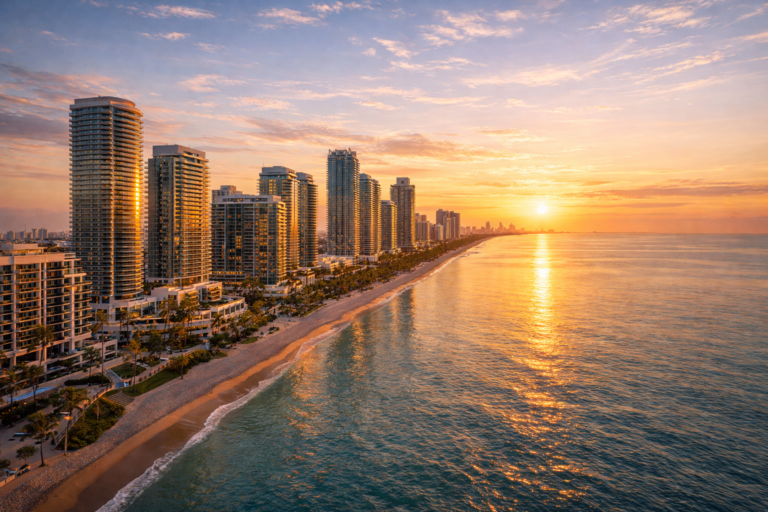
Miami attracts buyers from across Latin America, Europe and the rest of the US, helped by Florida’s lack of a state income tax. But owning in Miami carries costs that a price per square metre does not show: property taxes, high insurance premiums, and condominium rules tightened after the 2021 Surfside collapse. This page explains the headline figure and those costs.
What the headline figure means
Poyzo’s working figure for Miami is about €4,800 per m², a rounded average converted from dollars. Waterfront and newer luxury towers in Miami Beach, Brickell and Edgewater sit well above it; inland neighbourhoods and older condominiums sit below. US listings quote square feet (1 m² is about 10.76 sq ft).
Costs on top of the price
| Item | Typical amount | Notes |
|---|---|---|
| Documentary stamp tax on the mortgage | 0.35% of the loan | Only if financed; customarily paid by the buyer. |
| Intangible tax on the mortgage | 0.2% of the loan | Only if financed. |
| Owner’s title insurance | Set by Florida’s promulgated rates | In Miami-Dade the buyer traditionally pays; in much of Florida the seller does. |
| Deed stamp tax | Customarily paid by the seller | Negotiable. |
With these conventions, buyer closing costs in Miami are relatively low compared with Europe, often around 1% to 2% of the price for a financed purchase, before any lender fees.
Rules that affect owners
- No restrictions on foreign buyers of residential property. Non-resident buyers usually face higher deposits and rates if they borrow.
- Homestead exemption. Florida residents who make the home their primary residence get a reduction in assessed value and a cap on annual increases. Non-resident and investment owners do not, and their assessments can rise faster.
- Condominium safety rules. Since the Surfside collapse, Florida requires milestone structural inspections and fully funded reserves for structural items in older condominium buildings. Some associations have raised fees or levied special assessments as a result.
- When a foreign owner sells, US rules (FIRPTA) generally require the buyer to withhold 15% of the gross price for the tax authorities until the seller’s tax is settled.
Running costs after you buy
- Property tax is set by county, city and school district millage rates on the assessed value and is a significant annual cost.
- Insurance. Windstorm and flood cover are expensive in coastal Miami-Dade and have risen sharply in recent years.
- HOA or condominium fees cover building upkeep, reserves and amenities.
Worked example: what €400,000 buys
At €4,800 per m², €400,000 corresponds to roughly 83 m² at the city average, typically a two-bedroom condominium. Before buying, ask the association for the latest structural inspection, the reserve study and any planned special assessments, and get insurance quotes for the specific building.
Sources: Florida Department of Revenue (documentary stamp and intangible taxes), Miami-Dade County Property Appraiser (homestead exemption), Florida Statutes on condominium milestone inspections and reserves, IRS (FIRPTA withholding). Figures checked October 2026.
Related on Poyzo
- Car prices and running costs in Miami
- Service charges and building fees explained
- What happens tax-wise when you sell property abroad
- The costs of buying property abroad that are not the price
- Gross yield vs net yield: what eats the difference
- Compare your budget across all eight cities
Information only. This page explains how buying costs and rules are structured. It is not financial, tax, legal or immigration advice and it is not a recommendation to buy any property. Rates and rules change; confirm anything that affects a decision with the relevant authority or a qualified local professional.
Last updated: October 14, 2026